
Mention VAT to most people and you will usually get one of two reactions: complete panic or an argument about whether a Jaffa Cake counts as a cake or a biscuit.
Yet behind the scenes, VAT has quietly become one of the most commercially important and fastest-evolving areas of the London tax market.
From a recruitment perspective, the shift has been impossible to ignore. Firms are expanding indirect tax teams, investing heavily below Partner level and competing aggressively for experienced Managers, Senior Managers and Directors as regulatory scrutiny increases and clients demand more specialist advice.
London remains the centre of gravity. It is where the most complex international businesses operate, where the largest advisory projects land and where competition for experienced VAT professionals is fiercest.
Recent senior moves across the professional services market only reinforce that trend. Firms including Grant Thornton, Moore Kingston Smith and MHA have all strengthened senior leadership teams recently, particularly across financial services, advisory and specialist technical functions.
What has changed most is the role VAT now plays within businesses.
Indirect tax was once seen as a highly technical corner of the tax department. Today, VAT advisers are involved in everything from international expansion and supply chain restructuring to technology implementation, digital reporting and cross-border trade strategy. As financial and operational risks become more visible, businesses are relying on VAT specialists more heavily than ever.
That shift has changed the profile of the modern VAT professional too.
The strongest VAT specialists tend to combine technical expertise with commercial awareness and strong stakeholder management skills. They work closely with finance, legal, operations and technology teams rather than operating in isolation.
Career paths have also become far more fluid between practice and industry. A common route now involves training within a Big Four or Top 20 firm, moving in-house for broader commercial exposure and potentially returning to practice later as a Director or Partner-track hire.
Outside traditional accountancy practice, VAT specialists are most commonly employed within Financial Services, Management Consulting and Legal Services. Financial Services is the largest employer, accounting for 15% of the talent pool due to the complex compliance demands of banking and insurance markets. Management Consulting follows at 10%, with specialists focused on large-scale indirect tax and transformation projects, while Legal Services represents 6% of the market, typically hiring experienced VAT professionals to advise on structuring, cross-border risk and tax disputes.
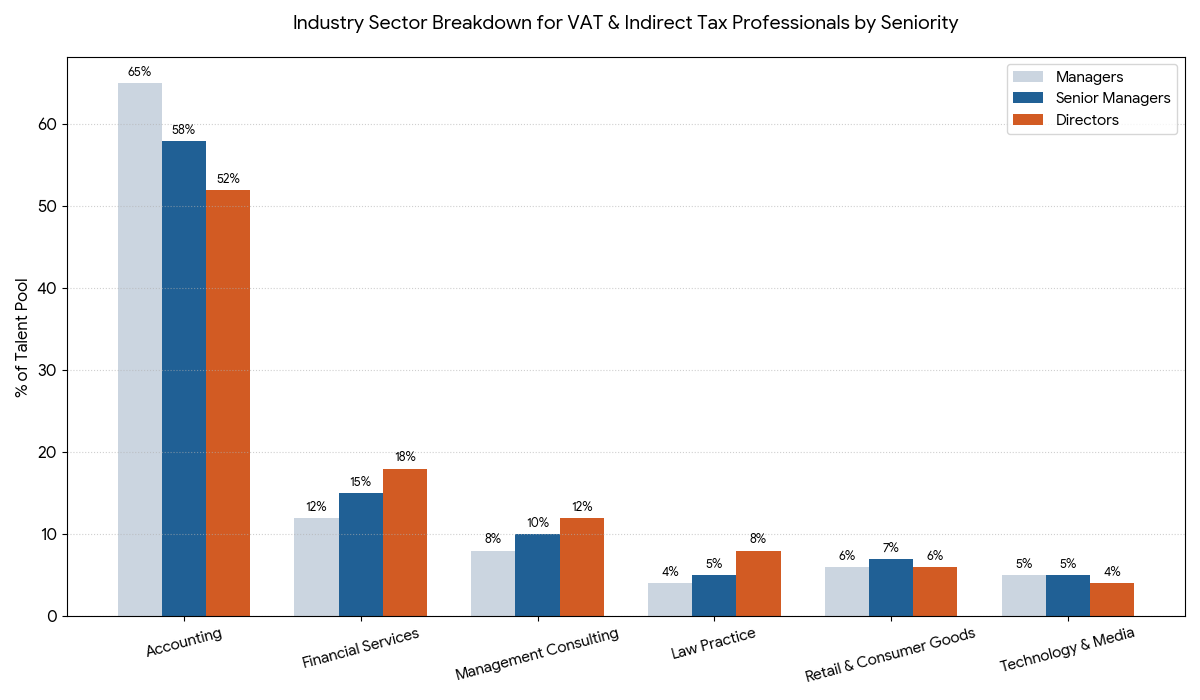
The market is especially competitive at Senior Manager level, where firms are fighting for professionals who can manage complex client relationships while still delivering practical commercial advice day to day. Industry demand is only adding to that pressure, with multinational groups, fintechs and fast-growth businesses all investing heavily in in-house VAT capability.
Partnership is no longer viewed as the only end goal either. Some professionals move into industry for broader commercial exposure or work-life balance, while others specialise in VAT technology, transformation or international advisory work. The career paths are becoming broader and far less traditional.
There is also something noticeably different about the gender balance within VAT. While tax as a profession still has progress to make at the most senior levels, indirect tax often appears more balanced than many other specialisms, particularly across Manager and Senior Manager populations.
Analysis of the UK VAT talent pipeline highlights an ongoing diversity challenge around the retention and progression of female professionals into senior leadership roles. While women make up a slight majority of VAT Managers at 52%, representation falls to 45% at Senior Manager and Associate Director level before dropping further at Director level, where men account for 66% of the market. The shift from a female-majority pipeline to male-dominated senior leadership highlights the need for firms to improve mid-career retention and create clearer pathways to partnership.
From a recruitment perspective, there are visibly more female leaders progressing through VAT than many people might expect.
.png)
Although regional markets such as Manchester, Belfast and Glasgow continue to grow, London remains the market everyone watches when it comes to senior VAT hiring and large-scale investment.
Which makes the irony quite interesting.
VAT may still sound like one of the least glamorous specialisms in professional services, but behind the scenes it has become one of the most commercially influential, technically varied and strategically important careers in the London tax market.
Not bad for a discipline still best known publicly for arguments about biscuits.